Design
Bruno Munari
Italian artist, designer, and inventor whose work across painting, sculpture, industrial design, graphic design, and children's books dissolved the boundaries between fine art and functional design in the twentieth century.
Why They Matter
Bruno Munari was born in Milan in 1907 and spent his youth in the Veneto region before returning to Milan at eighteen to join the Second Italian Futurist movement led by Filippo Tommaso Marinetti. During the late 1920s and 1930s, he created collages, sculptures, and his celebrated Macchine Inutili — hanging geometric mobiles that anticipated Alexander Calder's work and challenged the Futurist obsession with mechanical efficiency by celebrating purposelessness as an aesthetic value.
After World War II, Munari distanced himself from Futurism's proto-fascist associations and in 1948 co-founded the Movimento Arte Concreta (MAC), the Italian movement for concrete art. Through the 1940s and 1950s, he produced industrial designs for lighting, furniture, toys, and household objects that embodied his conviction that good design serves society by making everyday life more intelligent and beautiful. His client work for Danese, Olivetti, and other Italian firms established him as a central figure in the postwar Italian design miracle.
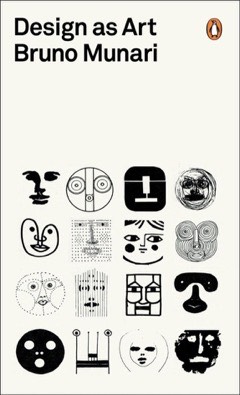
Munari's writing, particularly Design as Art, articulates a philosophy rooted in the belief that the designer, not the gallery artist, is the authentic creative force of modern life. His thinking was shaped by the Italian rationalist tradition, by Bauhaus pedagogy, and by an abiding faith in the educative power of play. His children's books, which use tactile surfaces, die-cuts, and unconventional materials, remain masterpieces of experiential learning design.
Munari's cross-disciplinary range — spanning painting, sculpture, film, industrial design, graphic design, poetry, and pedagogy — defies categorization and continues to inspire designers, educators, and artists worldwide. He died in Milan in 1998, leaving a body of work that insists creativity is not a luxury but a fundamental human capacity.